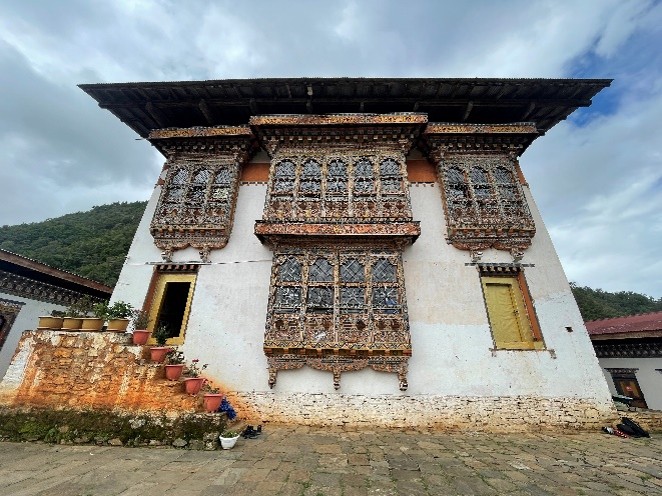
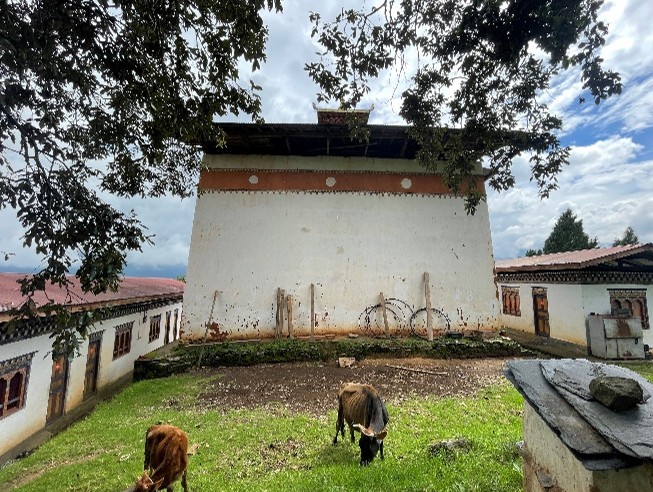
| Name: | Nalanda shedra |
|---|---|
| Identity: | Lhakhang |
| Level: | Registered Heritage Building |
| Category: | Heritage Building |
| Founder: | Je Sacha rinchen(Gyalwa shacha Rinchen had a vision of Tushita Heaven(ga dhen) the joyous Land . He had a pure vision of the clarifiers of teachings of Buddha known as the Six ornaments and the Two Su |
| Constructed(Year|Century): | | 18 |
| No. of Floor | 3floor |
| Main Wall | Stone |
| Location: | Toebisa, Punakha |
| Current Use: | Shedra |
| Ownership: | Government |
| Coodinates: | 27°32'28.56 |
Brief History
The buddhist institute is also known by the name Daley Goenpa or Dalina. The name Nalanda means insatiable giving.
It is said that this Monastery was established by Gyalwa Shakya Rinchen, The 9th Je Khenpo. Who is considered as the reincarnation of Rechungpa. Rechungpa was one of the two extraordinary disciples of Milarepa in the Kagyu Buddhist Lineage. The exact date of commencement of the monastery is inconclusive with different sources claiming different dates. According to the book seeds of faith it was built it was built when the Je khenpo was 40 years of age which was in 1750, However sign posts on the site claims the built date was 1757. Both dates are possible as the Je Khenpo lived till 1759.
At the time the monastery was built the Nalanda university in India was considered a very sacred and holy place. It was located in what was then called Magadha, present day Patna. Devoted Bhutanese would travel far and make great efforts to visit the holy place. The journey however, was very difficult being long and dangerous as they had to walk to India. Other challenges such as the differences in language,food and culture meant the Bhutanese pilgrims would have a very hard time there. So, it is said that Gyalwang Shakya Rinchen established the monastery and named it Nalanda to fulfil the wishes of the people and for them to gain merit without risking their lifes. The monastery is called the “Second Nalanda” and is said to be no different than the Nalanda in India. All merit achieved through pilgrimage of the Nalanda University is believed to be equivalent if one visits this one.
Nalanda Monastery is the second monastery built by Gyalwang Shakya Rinchen, the first being Phajoding monastery located in the mountains on the outskirts of Thimphu.It is said that Gyalwang Shakya Rinchen had completed the building of Phajoding monastery in Thimphu and was considering the location of the next one. The monk body was migrating from himphu to punakha according to tradition to spend the winter at Punakha Dzong.When they reached Dochula, It is said that Gyalwang Shakya Rinchen observed 8 vultures flying to an area o the hills opposite Dochula. Suspecting that they were the eight scholars of Nalanda University in India, HE sought confirmation and is accordingly said to have had a dream with the vision of the eight scholars who gave him teachings. So, it is believed that based on this the location of the establishment of the monastery was chosen. In other sources it is stated that the Jekhenpo had a vision of the eight scholars conducting religious discussions at this place which led to the location of the monastery being there.
While constructing the temples, Gyalwang Shakya Rinchen is said to have seen eight men in the adjacent valley. Believing them to be the eight scholars he decende to investigate but they had mysteriously vanished. This is believed to be the second vision of the eight scholars.
The Nalanda institute was very successful. Owing to the fame and spiritual prowess of the JEkhenpo. It thrived as a renowned buddhist institute during the Je Khenpo’s lifetime but after the Je Khenpo’s Thugdam (Passing away) the institute slowly shrank and lost its former glory.Many great teachers tried to revive the institute but failed. Until recently in 1911, The Dorji lopen Yoenten Gyeltshen appealed to the fourth Druk Gyalpo, His majesty Jigme Singye Wangchuck for its revival. Under Royal command Nalanda was re\\instituted as a shedra in 1992 and has since then had increasing number of students.